
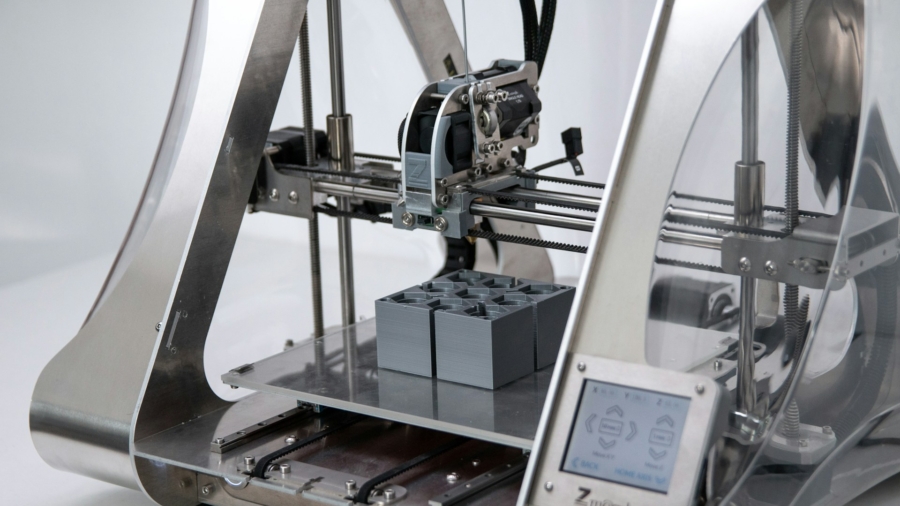
Manufacturing has entered a new era. Traditional methods that once dominated production floors are giving way to additive processes that build objects layer by layer. This shift isn’t just changing how products are made—it’s redefining what’s possible in custom manufacturing.
3D printing technology has moved far beyond prototyping novelties and trinkets. Today, industries from aerospace to healthcare rely on this industrial technology to produce complex, customized parts that would be impossible or prohibitively expensive to create through conventional means.
The ability to manufacture intricate geometries, reduce material waste, and produce small batches economically has made 3D printing an increasingly attractive option for businesses seeking competitive advantages. This transformation is backed by impressive market growth.
The global 3D printing market was valued at approximately $16.75 billion in 2022 and is projected to reach $76.17 billion by 2030, growing at a compound annual growth rate of 20.8%. These numbers reflect more than just hype—they signal a fundamental shift in manufacturing philosophy.
Speed and Efficiency Advantages
One of the most compelling benefits of 3D printing in manufacturing lies in its speed. Traditional manufacturing often requires weeks or months to produce tooling, molds, and fixtures before the first part can be made. Additive manufacturing eliminates many of these steps.
Rapid Prototyping Capabilities
Companies can now move from digital design to physical prototype in hours rather than weeks. This acceleration enables:
- Faster design iterations and improvements
- Quick response to market demands
- Reduced time-to-market for new products
- Lower development costs through early detection of design flaws
On-Demand Production
The shift to on-demand manufacturing represents a significant departure from traditional inventory management.
Instead of maintaining large warehouses filled with spare parts, companies can print components as needed. This approach reduces storage costs, minimizes obsolescence, and allows for just-in-time production strategies.
Customization at Scale
Mass customization—once an oxymoron—has become achievable through 3D printing. Unlike traditional manufacturing, where customization typically increases costs exponentially, additive processes maintain relatively consistent per-unit costs regardless of variation.
Personalized Medical Devices
Healthcare has embraced this capability with particular enthusiasm. Surgeons now use patient-specific implants, prosthetics, and surgical guides created from individual CT or MRI scans. These custom devices improve patient outcomes by:
- Ensuring precise fit and comfort
- Reducing surgery time
- Improving recovery rates
- Minimizing complications
Consumer Product Customization
Beyond medical applications, consumer goods manufacturers are exploring mass customization opportunities.
Eyewear companies produce frames tailored to individual facial measurements. Footwear brands create custom insoles matched to unique foot shapes. Jewelry designers offer personalized pieces at accessible price points.
Material Innovation and Diversity
The range of materials available for 3D printing has expanded dramatically. Early systems were limited to basic plastics, but modern industrial technology supports an impressive array of options.
Metal Printing Advances
Metal 3D printing has matured into a viable production method for critical components. Technologies like Direct Metal Laser Sintering (DMLS) and Electron Beam Melting (EBM) can work with:
- Titanium alloys
- Stainless steel
- Aluminum
- Nickel-based superalloys
- Cobalt-chrome
These capabilities have opened doors in aerospace, automotive, and energy sectors where metal parts must meet stringent performance requirements.
Composite and Specialty Materials
Beyond metals and plastics, manufacturers can now print with composites reinforced with carbon fiber, glass fiber, or Kevlar. Specialty materials include ceramics for high-temperature applications, bio-compatible materials for medical implants, and even flexible elastomers for rubber-like components.
Cost Considerations and Economic Impact
The economics of 3D printing present both opportunities and challenges. While the technology offers clear advantages in certain scenarios, it’s not universally cheaper than traditional methods.
When 3D Printing Makes Financial Sense
Additive manufacturing proves most cost-effective for:
- Low-volume production runs (typically under 1,000 units)
- Complex geometries that would require expensive tooling
- Lightweight designs that reduce material usage
- Parts consolidation that combines multiple components
- Products requiring frequent design updates
Investment and Operating Costs
Industrial 3D printing systems represent significant capital investments, ranging from tens of thousands to millions of dollars, depending on capabilities. Operating costs include:
- Material expenses (often higher per kilogram than raw materials for traditional manufacturing)
- Energy consumption
- Post-processing requirements
- Skilled operator labor
- Maintenance and system updates
Companies must carefully analyze their specific use cases to determine return on investment timelines.
Industry-Specific Applications
Different sectors have adopted 3D printing for distinct purposes, each leveraging the technology’s unique strengths.
Aerospace Engineering
Weight reduction drives aerospace applications. Every gram removed from an aircraft translates to fuel savings over its lifetime.
3D printing enables designers to create optimized structures with internal lattices that maintain strength while minimizing mass. Companies like GE Aviation produce fuel nozzles with 25% less weight and five times greater durability than traditionally manufactured versions.
Automotive Manufacturing
The automotive industry uses additive manufacturing for both prototyping and production. Applications include:
- Custom tooling and fixtures for assembly lines
- Low-volume specialty parts for luxury or limited-edition vehicles
- Replacement parts for discontinued models
- Performance components with optimized cooling channels
Architecture and Construction
Large-format 3D printing has entered the construction sector. Entire buildings can now be printed using concrete-based materials, offering potential solutions for affordable housing and rapid disaster relief construction.
Challenges and Limitations
3D printing shows immense promise, but it faces real constraints that prevent it from completely replacing traditional manufacturing methods just yet.
Production Speed Constraints
While it is incredibly fast for prototyping, 3D printing remains sluggish for mass production. Compare it to an injection molding machine, which can churn out hundreds of identical parts per hour. In contrast, a 3D printer might take several hours just to layer a single complex component.
Size Limitations
You are also limited by the machine’s physical “box.” Most printers have defined build volumes. If you want to create an object larger than the build chamber, you have to print it in separate sections and assemble them later. This extra step can introduce weak points and compromise the structural integrity of the final product.
Surface Finish and Post-Processing
Parts rarely come off the print bed ready for the shelf. They often emerge with rough surfaces and visible layer lines.
To get a finished look, you usually need to sand, machine, paint, or chemically smooth the item. These post-processing requirements add significant time and cost to the overall production workflow.
Quality Control and Certification
Ensuring that every part is identical remains a challenge. Variables like room temperature, humidity, and machine calibration can all change the outcome.
For industries with strict safety regulations, such as aerospace and medical, 3D printing often struggles to meet the rigorous testing and certification standards required.
Material Integrity and Durability
This issue of structural consistency is exactly why high-impact equipment still relies on traditional manufacturing. When safety and precision are paramount, you cannot risk a printed part failing under pressure.
For example, the best crossbows are engineered using high-strength composite materials and precision molding to handle immense kinetic energy—durability that standard 3D printing technology simply cannot match yet.
The Path Forward
3D printing continues to evolve rapidly. Researchers are developing faster printing methods, expanding material options, and improving quality consistency. Hybrid manufacturing systems that combine additive and subtractive processes in a single machine offer new possibilities.
The technology’s role in sustainability also merits attention. Additive manufacturing’s ability to reduce material waste, enable local production that cuts transportation emissions, and extend product lifecycles through on-demand replacement parts aligns with environmental goals many companies are pursuing.
Educational institutions are incorporating 3D printing into engineering and design curricula, ensuring the next generation of manufacturers understands both the capabilities and limitations of the technology. This knowledge base will drive continued innovation and more sophisticated applications.
Embracing Manufacturing’s Next Chapter
3D printing has moved beyond the realm of experimental technology to become a practical tool for custom manufacturing. Its ability to produce complex geometries, enable mass customization, and reduce material waste addresses real challenges facing modern manufacturers.
Success with this industrial technology requires understanding where it excels and where traditional methods remain superior.
Companies that thoughtfully integrate 3D printing into their manufacturing strategies—using it for appropriate applications while maintaining conventional processes where they’re more effective—will gain competitive advantages in flexibility, customization, and innovation.
The rise of 3D printing doesn’t signal the end of traditional manufacturing. Rather, it represents an expansion of the manufacturing toolkit, offering new possibilities for those willing to explore them.
As materials improve, speeds increase, and costs decline, the technology’s role in custom manufacturing will only grow more significant.